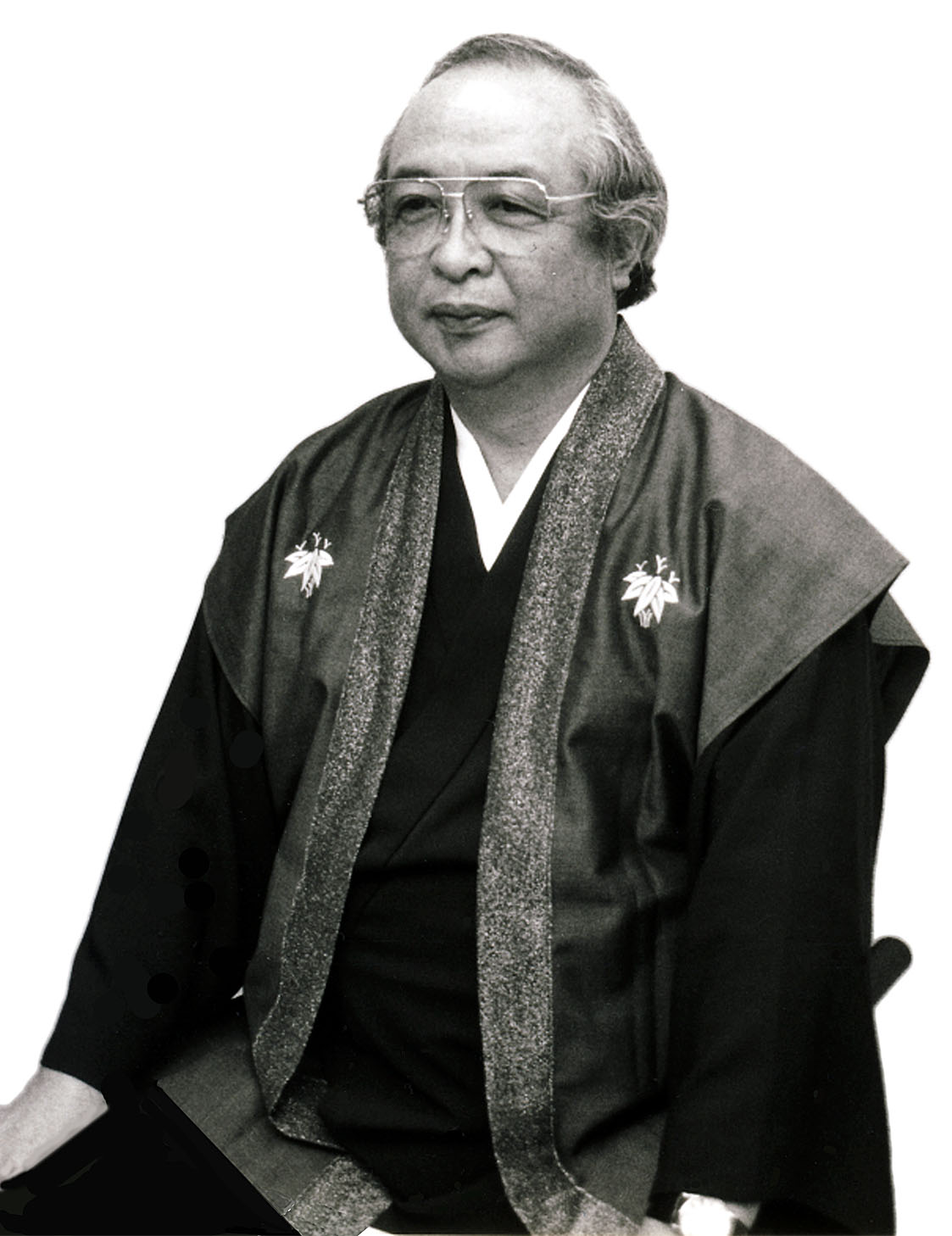
Katsuya Yokoyama was one of the greatest masters of
the shakuhachi in Japan today. He was born in Shizuoka Prefecture
in 1934 and studied Kinko-ryu and Azuma styles of music with his
father, Rampo Yokoyama, and grandfather, Koson Yokoyama.
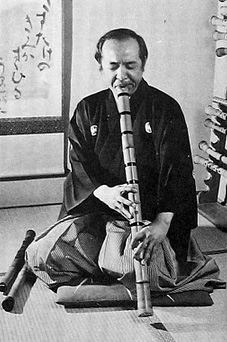
 At the age of 25, Yokoyama began to
study with Fukuda Rando, founder of the Azuma School and with
Watazumido-doso Roshi, a legendary Fuke master who sought to synthesize
shakuhachi music and spirituality within the context of Zen Buddhism.
Guided by these two eminent masters, Yokoyama was able to combine
the modernism of Rando with the deeply religious traditional spirit
of Watazumido in his training. With this foundation, he came to
develop a remarkably powerful and creative style that embodied
both ends of the continuum. A true descendant of the Kinko tradition
transmitted down through the generations, he also pioneered a
revolution in modern music that swept across post-War Japan.
At the age of 25, Yokoyama began to
study with Fukuda Rando, founder of the Azuma School and with
Watazumido-doso Roshi, a legendary Fuke master who sought to synthesize
shakuhachi music and spirituality within the context of Zen Buddhism.
Guided by these two eminent masters, Yokoyama was able to combine
the modernism of Rando with the deeply religious traditional spirit
of Watazumido in his training. With this foundation, he came to
develop a remarkably powerful and creative style that embodied
both ends of the continuum. A true descendant of the Kinko tradition
transmitted down through the generations, he also pioneered a
revolution in modern music that swept across post-War Japan.
In 1960, Yokoyama completed
his studies at the NHK Japanese Traditional Music Training Center. Oone year later, he formed Shakuhachi San-Jyuso-dan with Kohachiro Miyata and Minoru Muraoka, a trio devoted
to furthering new music for the instrument. In 1963, he founded
the Nihon Ongaku Shudan (Japanese Music Group) and Shakuhachi
Sanbon-kai (Group of Three Shakuhachi ) with Kinko master Aoki
Reibo and Tozan master Hozan Yamamoto. This historic group 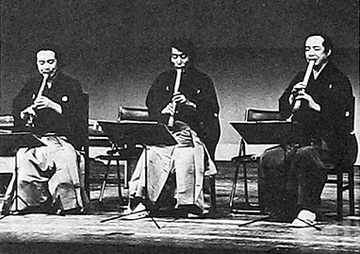 helped
to establish a new genre of music for shakuhachi trio.
helped
to establish a new genre of music for shakuhachi trio.
In 1967, Yokoyama was selected
by the renowned composer Toru Takemitsu to perform the premiere
of November Steps, his modern composition for shakuhachi, biwa
and orchestra led by Seiji Ozawa and the New York Philharmonic.
Since its opening over thirty five years ago, Yokoyama has performed
this epic piece hundreds of times around the world.
Katsuya Yokoyama founded the Chikushin-kai Shakuhachi
Guild. He has been the recipient of many prestigious awards, amongst
them the Geijutsu Sen-sho (Art Award) in 1971, the Geijutsu-sai
Yushu-sho (Art Excellence Award) in 1972, the Geijutsu-sai Tai-sho
(Art Festival Grand Prize) in 1973 given by the Agency for Cultural
Affairs and the Ongaku no Tomo-sha Award in 1991.
In 1988, Yokoyama founded the Kokusai Shakuhachi Kenshukan (International Shakuhachi Training Center) located in Bisei-cho,
Okayama, Japan where he hosted the first International Shakuhachi
Festival in 1993. This event precipitated founding of the World
Shakuhachi Society and Festival held in Boulder, Colorado in 1998.
At this gathering, five of the world's greatest shakuhachi masters,
including Yokoyama, performed in a single venue for the first
time ever.
In 2002, the Japanese government
honored Yokoyama for a lifetime of achievement by awarding
him the esteemed Shiju Hosho (Purple Ribbon Medal) award.
Katsuya Yokoyama passed away on April 21, 2010, leaving a rich legacy of shakuhachi tradition as a gift to the world.
 |
Yokoyama-sensei
writes about this edition:
"Using the fingering charts along with
the scores themselves, players from any shakuhachi school or lineage
should be able to play the songs. Honkyoku have free rhythm, so
the player will have to listen to examples of the song being played,
then intuitively grasp the timing or ma of each phrase
for themselves. Notes on the playing techniques have been included.
We chose a form of writing that make it easy to visually grasp
aspects such as the length of the notes, the speed of the ornamental
sounds and pitch changes. We did not use the symbols that express
rhythm, which differ from school to school. The symbols for the
notes themselves are written in the Kinko style, but use of the
fingering chart should enable players from any school to adapt
easily.
"The 1.8 shakuhachi is
the most common length, making it the best reference for any self-learner.
In truth, however, the spirit of each honkyoku is best expressed
on its own length flute. This judgment is highly subjective, so
we cannot prescribe a specific flute length for each song. But,
in general, we can state that a flute length of 2.1 or greater
will result in a better feeling for these pieces. We highly recommend
longer flutes. With a little practice, even those with smaller
physiques should be able to play a length of at least 2.4 with
no problems.
"Due to the fact that honkyoku have been passed on by
oral transmission, there are many songs with the same title but
different melodies as well as songs with different titles but
the same melody. The names of songs used here are as transmitted
me. Remember that interpretation of the songs will differ completely
from player to player during actual performance. It is important
for those who use the scores to understand the characteristics
of classical honkyoku. This collection of honkyoku has been published
as one reference amongst many in order to give players an opportunity
to deepen their understanding of classical shakuhachi honkyoku." |
Table
of Contents
Introduction
Characteristics of Honkyoku
Concerning the Honkyoku Scores
About the Scores
Conclusion
Classical Shakuhachi Honkyoku Scores
The Notes
Note Extension Lines
Symbols and Notation
Korokoro Techniques
Important Remarks
Non-Vibrato
The Correct Pitch for Meri Sounds
Practicing Honkyoku
Ha-Ro: From the Basic to the Sublime
Chi-Ru or Eru no Te
The Rhythm of Tatami-Komi
Glossary
This edition also
includes a detailed Fingering Chart correlating Japanese
cursive and Western 5-line staff notation.
YS-1 scores. 11"
x 17" format. Complete set is packaged in a hard cover 3-ring
binder notebook. Published by Tai Hei Shakuhachi. ISBN 0-9722878-9-2
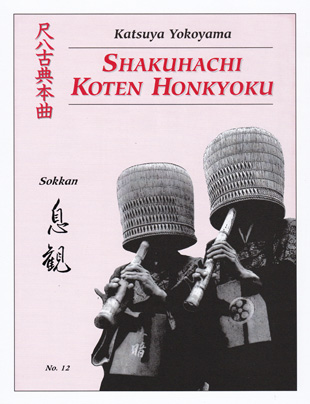
Music Notation
for Sokkan
List
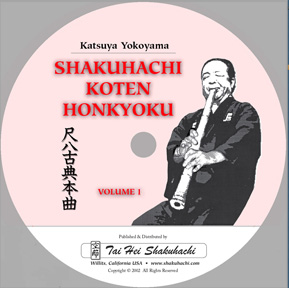
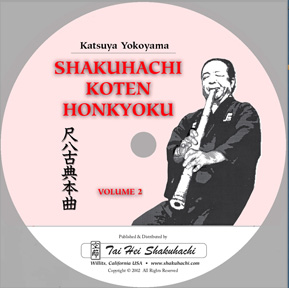
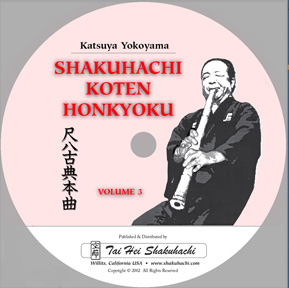
of Classical Shakuhachi Honkyoku Scores, Sheet Music & Three-CD Set
This 3 CD set includes
all of the pieces in the accompanying collection of sheet music.
All honkyoku are performed by Katsuya Yokoyama on a 1.8' shakuhachi.
Each score is printed on 11" x 17" folder. Some pieces require two folders.
 |
Volume
1 |
Number |
Title |
Pages |
Time |
1 |
Azuma Jishi |
1 |
2:58 |
2 |
Nezasa Shirabe |
1 |
3:11 |
3 |
Nezasa Sagariha |
1 |
4:11 |
4 |
Tamuke |
1 |
4:47 |
5a/b |
Sanya [Version 1] |
2 |
7:40 |
6 |
Shingetsu |
1 |
5:55 |
7a/b |
Sanan |
2 |
7:40 |
8 |
Yamagoe |
1 |
5:03 |
9 |
Koden Sugumori (Suzuru) |
1 |
5:00 |
|
 |
Volume
2 |
Number |
Title |
Pages |
Time |
10a/b |
Koku |
2 |
12:04 |
11 |
Daha |
1 |
5:12 |
12 |
Sokkan |
1 |
5:01 |
13 |
Sanya [Version 2] |
1 |
10:30 |
14a/b |
Hifumi Hachigaeshi |
2 |
8:024 |
15 |
Honshirabe |
1 |
3:236 |
16 |
Tsuru no Sugomori |
1 |
6:123 |
|
 |
Volume
3 |
Number |
Title |
Pages |
Time |
17a/b |
Shoganken Reibo |
2 |
11:28 |
18a/b |
Reibo |
2 |
11:17 |
19a/b |
Ukigumo |
2 |
8:55 |
20 |
Shika no Tone |
1 |
9:42 |
21a/b |
Takiochi |
2 |
6:32 |
22a/b |
Kumoi Jishi |
2 |
3:55 |
|
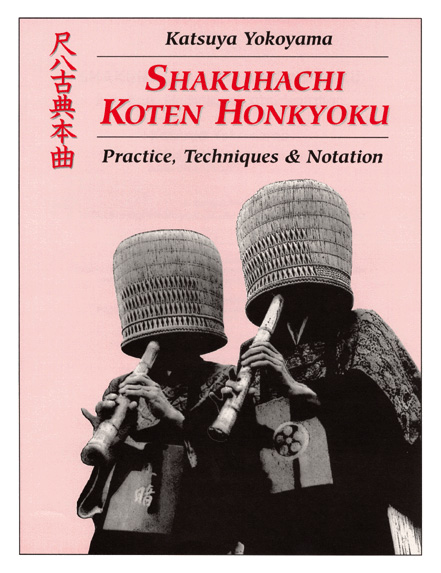
 Also available, this excellent complement to Yokoyama's comprehensive 3-volume edition, SHAKUHACHI
KOTEN HONKYOKU: Practice, Techniques & Notation as well as the performance video KATSUYA YOKOYAMA PLAYS RANDO FUKUDA: Excellent Pieces for Shakuhachi.
Also available, this excellent complement to Yokoyama's comprehensive 3-volume edition, SHAKUHACHI
KOTEN HONKYOKU: Practice, Techniques & Notation as well as the performance video KATSUYA YOKOYAMA PLAYS RANDO FUKUDA: Excellent Pieces for Shakuhachi.
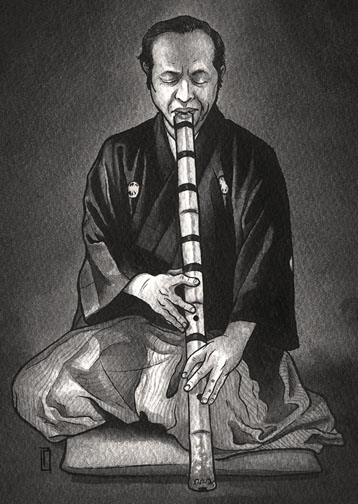 |
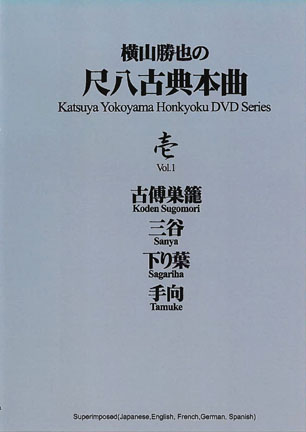
In these extraordinary teaching videos, Katsuya Yokoyama (1934-2010) founder of Kokusai Shakuhachi Kenshukan, performs in their entirety eight of the most important shakuhachi honkyoku pieces.
The International Shakuhachi Training Center in Beisei, Japan was originally conceived and founded by Yokoyama Katsuya, one of the premier shakuhachi players, teachers and stylists of the 20th century. His driving vision was to establish a study group that would be truly international in scope, and to create a training center in Japan that would attract students from the world over to come and learn classical honkyoku as he taught it.
These videos were recorded some years ago by Yokoyama-sensei as an aid to his students at the KSK. They are not merely performance videos, but an invaluable resource including Yokoyama playing the main honkyoku pieces on a classical size 1.8' shakuhachi, as well as discussing nuances and key elements of the music from his unique perspective. They serve as an excellent complement to Yokoyama's comprehensive 3-volume edition, SHAKUHACHI
KOTEN HONKYOKU: Practice, Techniques & Notation
Volume 1
Koden Sugomori, Sanya, Sagariha, Tamuke
V-33 / 56 min. 6 sec.
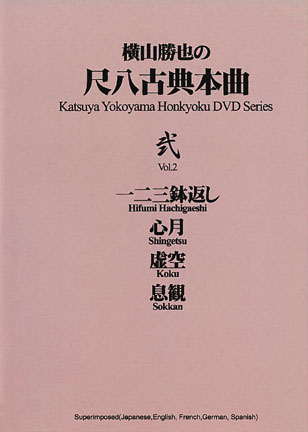
Volume 2
Hifumi Hachigaeshi, Shingetsu, Koku, Sokkan
V-34 / 68 min. 31 sec.
Both Volumes 1 & 2 are Japanese Language with Superimposed Subtitles
in English, French, German & Spanish
Recorded in NTSC quality video standard, these DVDs are Region Free, so playable on devices worldwide.
Coming Soon
Volume 3
Yamagoe, Daha, Neza-Shirabe, San-An
Volume 4
Azuma Jishi, Sanya, Hon Shirabe, Tsuru no Sugomori |
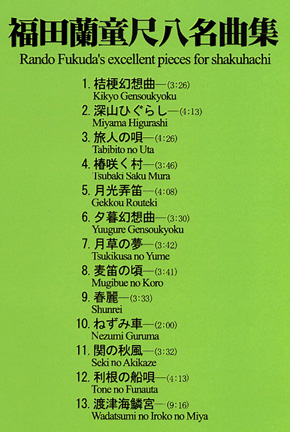
Produced in Japan, this special 20th Anniversary reissue of the compositions of famed composer Fukuda Rando features the late Katsuya Yokoyama along with the three most senior members of Kokusai Shakuhachi Kenshukan, Teruo Furuya, Kasushi Matama and Kaoru Kakizakai. Originally released as a VCR in 1991, this new DVD allows us of to see and hear Yokoyama-sensei perform in the prime of his life in ensemble with his most devoted followers. Koto and jushichigen selections performed by Michiko Onari and Taeko Kamijyo.
 Sheet Music Menu
Main Menu
Tai Hei Shakuhachi
Homepage